The Inner Game of the Long Run
Words & Photography: Amanda Ramplin
The body was never the hard part.
The legs are the easy part. That’s a strange thing to say about a sport built on training your legs, but ask anyone who has been out past the three-hour mark and they’ll tell you the same. You can build the engine. That part is repetitive, it’s just months of turning up. What you cannot build the same way is whatever it is that keeps you going once the engine is fine and everything else in you has decided it would rather not.
It never happens at the start. At the start I’m full of good intentions and fresh legs and a completely unearned sense that today is going to be a good one. It doesn’t happen in the middle either, usually, when the rhythm has taken over and you stop thinking. It creeps in later, when the novelty is gone and the coast still stretches on and there is a lot of run left and none of it is fun anymore. That’s the bit. That’s where it actually gets decided, and it doesn’t get decided in the legs.
Here is the thing I’ve slowly worked out, mostly the hard way. The voice that starts telling you to stop is not you being soft. It’s your brain doing exactly what it’s built to do. The brain’s whole job is to keep you alive, and it treats hours of self-inflicted discomfort as a problem to be solved, so it gets to work solving it. Slow down. Walk the next bit. You’ve done enough for today. Nobody’s watching, nobody would know. And the reason it’s so hard to argue with is that it isn’t being cruel. It genuinely thinks it’s helping. The annoying part is that it’s nearly always wrong about what the body can still do.
I used to think the goal was to shut that voice up. Be tougher. Want it more. I don’t believe that anymore, partly because it doesn’t work and partly because trying is its own kind of exhausting. You don’t beat the doubt by getting rid of it. You get rid of nothing. You just stop letting it drive.
You’re not going to silence the commentator. What you can do is stop taking it at its word.
There are two of you out there on a long run. One is running. The other is sitting a little way back with a running commentary, and most of what it says is unhelpful and a fair bit of it is nonsense. You’re not going to silence the commentator. What you can learn to do is stop taking it at its word.
Motivation is useless for any of this, which nobody wants to hear. People assume you have to be some bottomless well of it to run long. You don’t. Mine comes and goes with the terrain, it can disappear entirely on a climb and be back by the top of the same climb, twenty minutes later, like it never left. If I waited to feel like running, I’d never get anything long done. What actually holds when the motivation walks off is much more boring than motivation. It’s just the next small thing.
The mind can’t hold eighty kilometres. It can always hold the next tree.
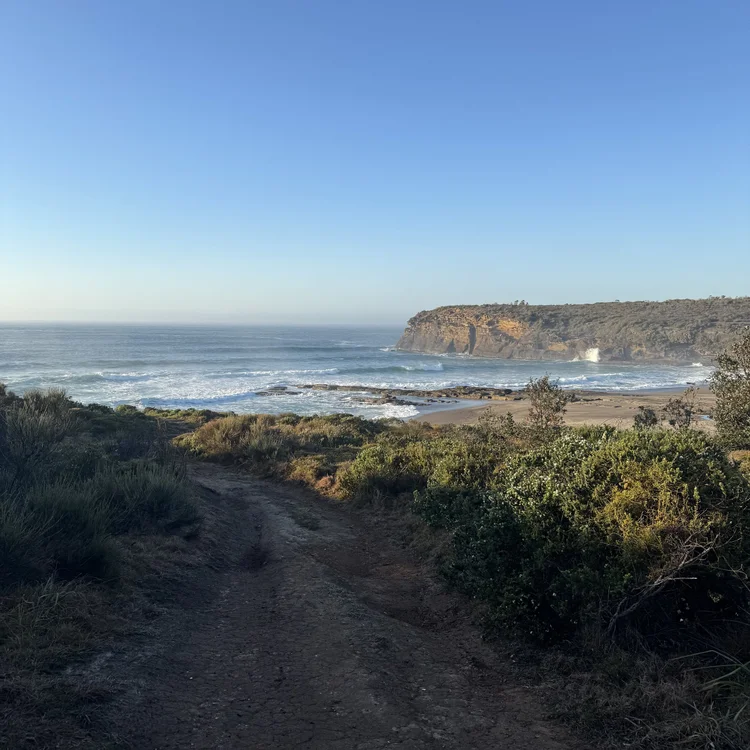
Not the whole distance. The whole distance is a trap. Say the real number to yourself and your mind hears “impossible” and immediately starts drawing up the exit plan. So I don’t. I run to the next headland. Then the one after that. On my home coast I basically get myself back one point of land at a time, and I’ve caught myself doing the maths, how far to that headland, then getting it wrong and having to redo it, and honestly the maths is half the point, because while I’m busy with it I’m not busy quitting. The mind can’t hold eighty kilometres. It can always hold “the next tree.”
The feelings don’t hold still either. In one hour I’ve gone from sure I’d finish, to sure I wouldn’t, to weirdly happy just to be out, to genuinely annoyed at a hill, and back around again. I used to take each of those seriously, as though a bad patch were telling me something true about the day. It isn’t. A bad patch is just a bad patch, and it lifts. So does the good one, for what it’s worth. Neither of them is the weather report. You keep going and you let them pass through you.
That’s the whole lesson, really, and it took me a long time and a lot of ordinary suffering to get it. None of it, in the end, is about running. It’s about what you do when something is hard and no one is around to see how you handle it, and whether you can keep making one more sensible decision when you’ve got no guarantee it’ll be worth it.
You don’t need to run eighty kilometres to meet the version of yourself that shows up out there. You just need to go far enough that your mind starts trying to make a deal. And then, this time, not take the first offer.