What’s in my vest.
There’s a particular flavour of online commentary aimed at runners wearing a hydration vest on what someone has decided is too short a run. Here’s why I wear mine anyway, and what actually goes in it.
You’ll have seen it. A photo of someone in a vest on a five kilometre loop, and underneath it, someone explaining, at length, that this is overkill, that vests are for actual ultras, that wearing one on a casual jog is basically dressing up as an athlete you’re not.
If I’m headed to the coast track, the vest goes on, and I couldn’t care less what a stranger on the internet has decided that says about me. It’s not a costume. It’s where my water lives, my keys, my phone, my sunglasses for whenever the sun decides to show up an hour into the run. None of that changes because the loop is short. I’ve been caught out on a “quick” run before, weather turns, a twenty minute plan becomes ninety, and the vest is the difference between managing that calmly and not. I’m not carrying it to look a certain way. I’m carrying it because I’ve learned the hard way what happens when I don’t.
What gets me about the shaming is how badly it misreads what trail running actually rewards. Road running has its clock and its splits and, fairly or not, a hierarchy built around pace. Trail never had that option available to it. A steep pinch turns a strong runner into someone power hiking within a hundred metres, and nobody thinks less of them for it, because the next climb will do exactly the same thing to whoever’s watching. Out here, walking a hill isn’t a failure. It’s just what the ground asks of everyone eventually, whether they’ve done one ultra or ten.
Out here, walking a hill isn’t a failure. It’s just what the ground asks of everyone eventually.
I think that’s part of why the culture out here ends up so different from the road. You’re often alone, or a long way from help, and the terrain doesn’t care how experienced you are. That seems to breed watchfulness rather than competitiveness. Runners will hand you route beta before a race without being asked twice. Someone always seems to hang back near the tail of a field, not because they’re struggling, but because they’ve quietly decided that’s their job for the day. At a finish line, people stay long after the winners are done, just to clap the last runner in the same way they clapped the first. I’ve been that last runner. It matters more than you’d think, having someone still there.
None of that leaves much room for sneering at a vest. If anything, the runner who’s over-prepared for a short loop is doing the one thing this whole culture is built on, taking the terrain and the risk seriously, rather than assuming it’ll be fine because the distance looked small on a map.
So, in the spirit of taking it seriously rather than guessing, here’s what actually goes with me, depending on what the day’s asking for.
Short runs
For anything short I’m still in my North Face Summit Series Run Vest 10, which is honestly more vest than a five or ten kilometre loop strictly needs. That’s sort of the point though. There’s enough room in it that if the sky looks even slightly undecided, a light jacket goes in without a second thought, along with the usual keys, phone, sunglasses and whatever hydration the day calls for. I’ve got mine in the alpine floral print, and I’ll admit that’s not a purely practical choice. It makes me happy every time I put it on, and there’s something to be said for that. Gear you actually love is sometimes the thing that gets you out the door on a morning when nothing else would have.
Long runs
Same vest, same everything, with nutrition added once the distance stretches out. Whatever I’m training with at the time goes in, since I’m always trying to match race day fuelling rather than experimenting on the run itself. A banana rides along more often than not, it’s unglamorous and it works.
Ultras
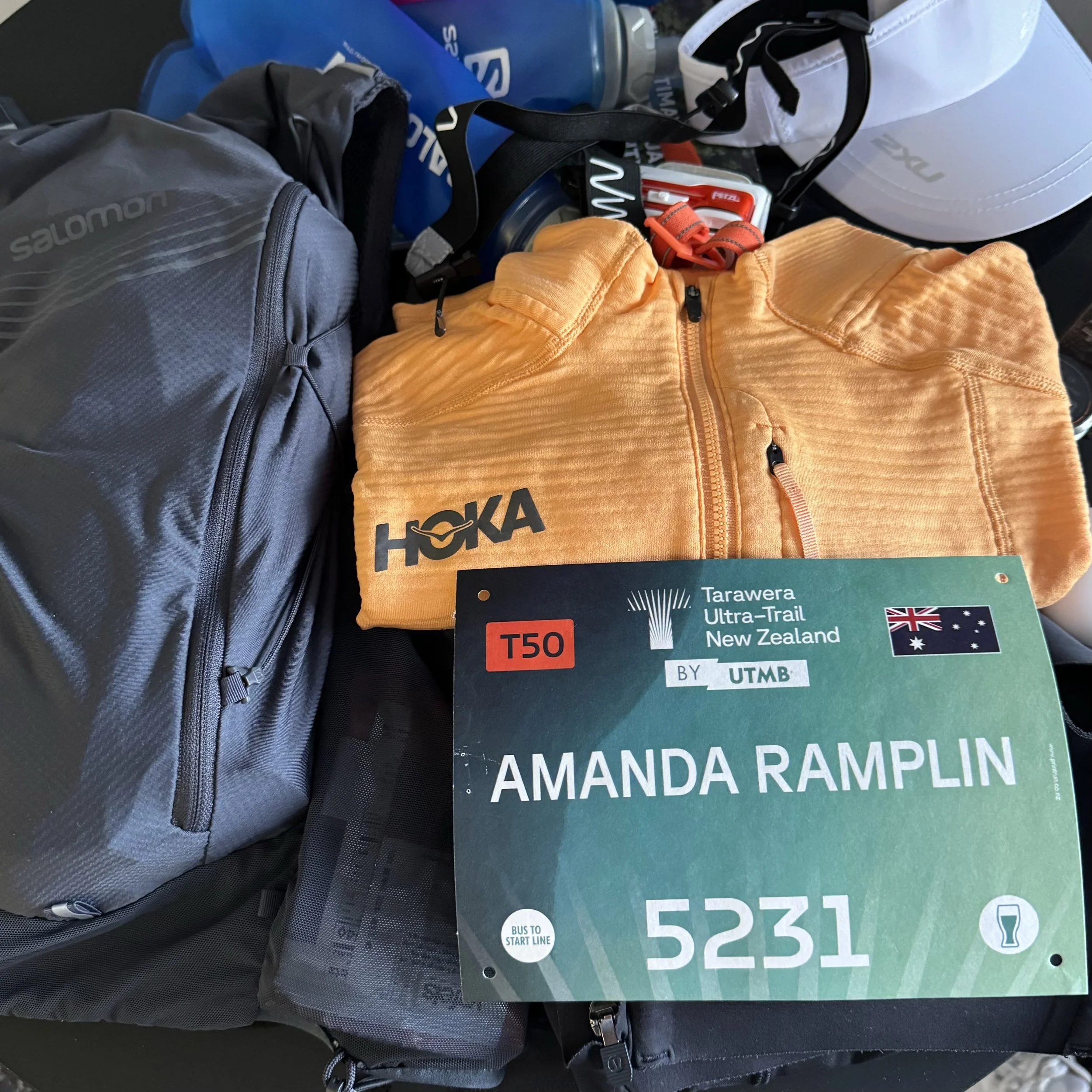
This is where the Salomon ADV Skin Set 12 comes in, and it’s one of the few bits of kit I’d call genuinely loved rather than just used. I’ve had an old version for years and I’m currently putting the newer one through its paces ahead of next year’s race, more on that comparison over on the Kit page if you’re curious. An ultra carries its own non-negotiables regardless of what vest you’re wearing, a map and compass, a basic medical kit with bandages, a head torch, an emergency blanket, and a long sleeved top and pants that actually wick sweat rather than just claiming to. All of that sits alongside whatever nutrition and hydration the distance demands, which by that point is usually a fair bit.
Gear you actually love is sometimes the thing that gets you out the door on a morning when nothing else would have.
Road or a walk
Depending on the distance, it’s either the same North Face vest again or the Satisfy Space-O running belt, also reviewed properly on the Kit page. The belt earns its place on shorter, lower-stakes outings where I don’t need the storage or the water capacity of a full vest, just enough to carry the basics without thinking about it.
None of this is dramatic, and none of it is the same kit for every run. It’s just what a few badly timed weather changes, and a few years of getting it wrong, have taught me to trust.